
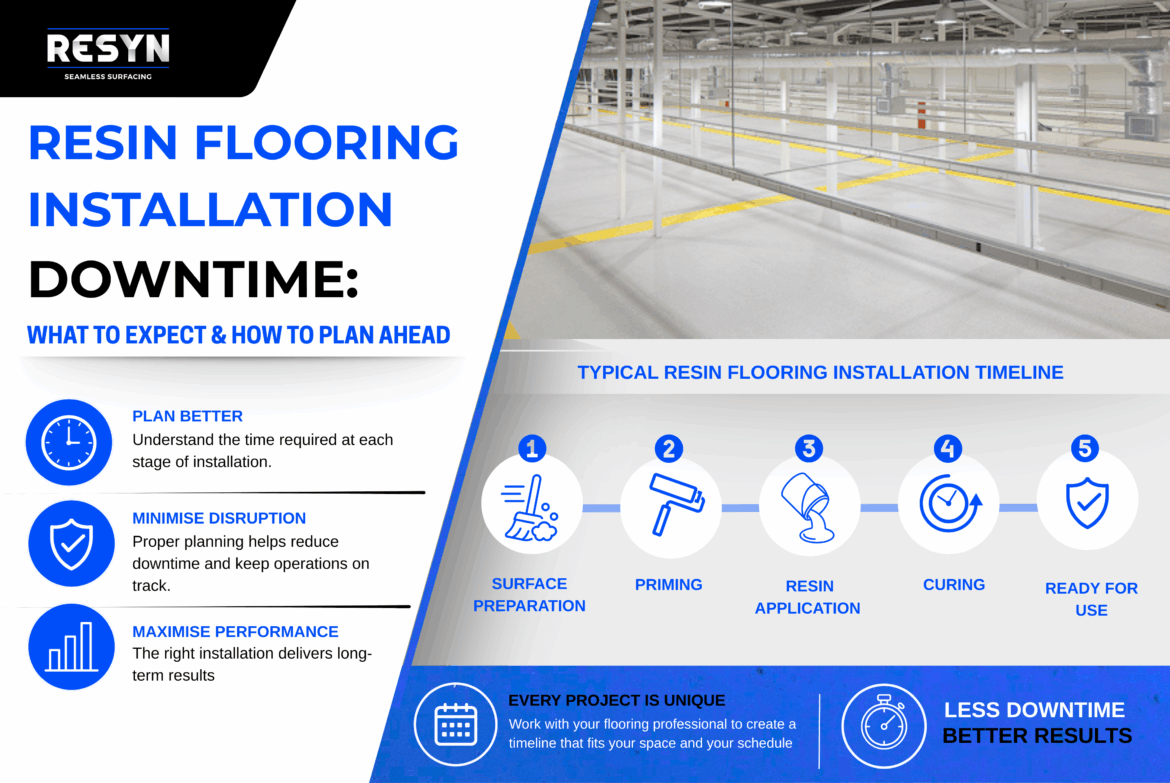

When planning a new resin flooring installation, one of the most important considerations is downtime. Whether the project is taking place within a busy manufacturing facility, warehouse, retail environment, food production area, or commercial premises, understanding how long an area will be out of service is essential for minimising disruption and maintaining productivity.
The downtime associated with resin flooring systems can vary significantly depending on the type of resin selected, site conditions, substrate preparation requirements, and the intended use of the floor. While every project is unique, understanding the characteristics of the most common resin flooring systems—MMA, epoxy, and polyurethane—can help businesses make informed decisions when scheduling installation works.
Why Downtime Matters
Downtime refers to the period during which an area cannot be used while flooring works are being completed and the new surface is curing. For industrial and commercial environments, prolonged downtime can affect operations, production schedules, staff movement, customer access, and revenue generation. All of these factors can significantly affect refurbishment and new-build schedules. Therefore, it is essential to identify the project requirements from the outset and determine the most suitable product specification and programme schedule for the project.
For industrial facilities, prolonged downtime may disrupt manufacturing schedules, warehouse operations, or supply chain activities. In commercial settings, such as retail stores, offices, healthcare facilities, and hospitality venues, downtime can affect customer experience, employee access, and business continuity.
By understanding the installation timeline of different resin flooring systems, facility managers and project teams can make informed decisions that minimise disruption while achieving the required performance standards.
MMA Resin Flooring: The Fastest Return to Service
Methyl Methacrylate (MMA) flooring systems are widely recognised for their rapid curing capabilities. Unlike many alternative resin systems, MMA floors can cure quickly even in low temperatures, making them particularly suitable for environments where downtime must be kept to an absolute minimum. The curing time of MMA resins is largely unaffected by temperature.
Typically, an MMA floor can be ready for light foot traffic within one to two hours of installation, with full operational use often achievable after just two hours. This exceptionally fast turnaround allows contractors to complete installations during evenings, weekends, or planned shutdown periods without causing significant operational disruption.
MMA flooring is often selected for:
- Food and beverage production facilities
- Cold storage and freezer environments
- Distribution centres
- Retail outlets
- Pharmaceutical manufacturing areas
- Commercial Kitchens
The primary advantage of MMA systems is the ability to complete projects and return spaces to service on the same day. For organisations where every hour of downtime carries a financial cost, MMA flooring often provides the most practical solution.
However, project planning should still account for substrate preparation and any repairs that may be required before installation, as these factors can influence overall project duration.
Epoxy Resin Flooring: A Cost-Effective Solution
Epoxy resin flooring remains one of the most widely used flooring systems across industrial and commercial sectors due to its durability, chemical resistance, and cost-effectiveness.
While epoxy systems offer excellent long-term performance, they generally require longer curing periods than MMA alternatives. Depending on environmental conditions, floor specification, and product formulation, epoxy coatings may allow light foot traffic after 12 to 24 hours. Vehicle traffic and full operational loading may require between 48 and 72 hours, with some heavy-duty systems requiring even longer curing times and up to 7 days for full operational use.
Epoxy flooring is commonly used, particularly as a floor coating, in:
- Warehouses
- Manufacturing facilities
- Engineering workshops
- Commercial buildings
- Educational facilities
- Storage areas
Because of the longer curing process, epoxy installations often require more extensive planning. Many businesses schedule installations during holiday periods, planned maintenance shutdowns, or phased refurbishment programmes to minimise operational disruption.
Environmental conditions play a significant role in epoxy curing times. Lower temperatures and higher humidity levels can extend curing periods, while controlled indoor environments may help maintain predictable installation schedules.
For facilities that can accommodate a longer downtime window, epoxy flooring provides a highly durable and economical flooring solution capable of withstanding demanding operational conditions.
Polyurethane Resin Flooring: Performance for Demanding Environments
Polyurethane resin flooring systems are frequently specified for environments exposed to thermal shock, chemical attack, heavy traffic, and demanding cleaning regimes. They are particularly popular within food manufacturing, beverage production, and heavy industrial settings due to their robustness within these demanding environments.
Downtime requirements for polyurethane flooring generally fall between MMA and epoxy systems, although exact timings vary depending on the specific product and installation thickness.
Many polyurethane systems can accept light foot traffic within 12 to 24 hours, while heavier operational use may require 24 to 48 hours before the floor reaches sufficient strength. Some specialist formulations may require additional curing time before exposure to aggressive chemicals or high-temperature cleaning procedures and this can be up to 5-7 days.
Typical applications include:
- Food processing plants
- Breweries and dairies
- Commercial kitchens
- Chemical processing facilities
- Heavy industrial manufacturing environments
The key advantage of polyurethane flooring lies in its durability and resistance to harsh operating conditions. Although installation may involve slightly longer downtime than MMA systems, the long-term performance benefits often justify the investment, particularly in demanding production environments.
Factors That Influence Installation Downtime
While resin type is a major factor in determining downtime, several other considerations can affect project schedules.
Surface Preparation
Existing floor conditions can significantly influence installation timelines. Repairs, crack treatment, contamination removal, moisture mitigation, and mechanical preparation all require time before the resin system can be applied. For all screeding applications, consideration must be given to the required curing time before the resin flooring system can be installed.
Environmental Conditions
Temperature and humidity can affect curing rates. Cooler conditions generally slow curing, particularly for epoxy and polyurethane systems, while warmer environments may accelerate installation schedules.
Floor Thickness
Heavy-duty industrial systems are often installed at greater thicknesses than decorative commercial coatings. Thicker systems may require additional curing time before full service can resume. It is important to note that suppliers and manufacturers may also recommend longer curing times to achieve resistance against specific environmental conditions or elements.
Traffic Requirements
Different levels of traffic require different curing milestones. A floor that is suitable for pedestrian access may not yet be ready for forklift traffic, pallet movement, or production equipment.
Project Size
Larger projects may be completed in phases to maintain operational continuity. Phased installations can reduce disruption but may extend the overall project duration and budget costs.
Choosing the Right Resin Flooring System
Selecting the most appropriate flooring solution requires balancing performance requirements against acceptable downtime.
If rapid return to service is the primary objective, MMA flooring typically offers the shortest installation window and fastest cure times. Where durability and cost-effectiveness are prioritised and longer shutdown periods are acceptable, epoxy flooring remains a popular choice. For facilities operating in harsh industrial environments requiring exceptional thermal and chemical resistance, polyurethane flooring often provides the best long-term solution.
Early consultation with an experienced resin flooring contractor can help establish realistic project timelines, identify potential challenges, and develop an installation programme that minimises disruption to operations.
Conclusion
Downtime is a critical consideration in any resin flooring project. Understanding the curing characteristics of MMA, epoxy, and polyurethane systems enables businesses to plan effectively and minimise operational disruption. However, curing time is only one element affecting project downtime. Other activities and constraints associated with the flooring installation may also impact the overall downtime and should be considered as part of the planning process.
MMA systems offer the fastest return to service, often within hours. Epoxy flooring delivers excellent durability but generally requires several days before full use. Polyurethane flooring provides exceptional performance in demanding environments with moderate curing periods.
By assessing operational requirements alongside installation timelines, industrial and commercial facilities can select a flooring solution that delivers both performance and practicality, ensuring a successful installation with minimal impact on day-to-day operations.
Need further assistance?
If you would like to discuss a potential flooring project and how this would impact your operational processes, please contact our experienced resin flooring team for advice.
Our team specialises in commercial resin flooring and industrial resin flooring systems for a wide range of environments.
If you would like further advice, arrange a site survey, or request resin flooring samples, contact our team today and we will be happy to help.
Author: Anna Dewdney