
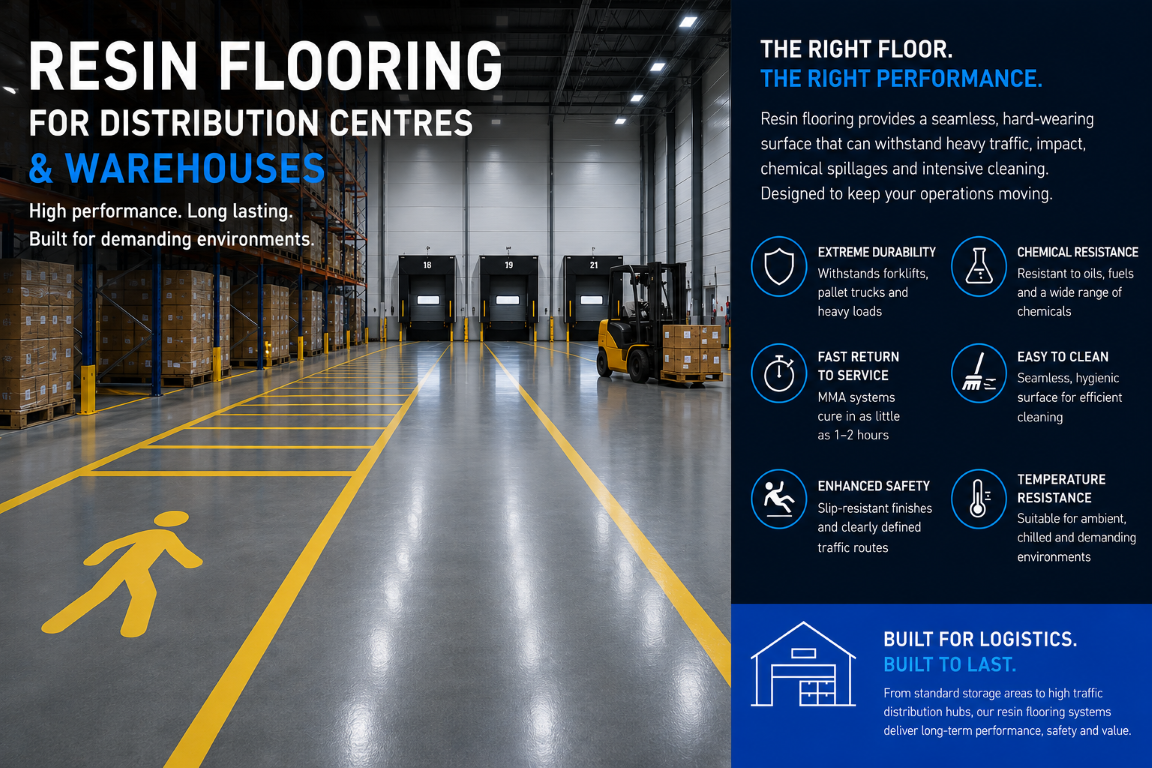

Resin Flooring Guide for Distribution Centres and Warehouses
Distribution centres and warehouses place some of the most demanding requirements on a floor. Unlike many commercial environments, warehouse floors are subjected to continuous forklift traffic, pallet trucks, heavy racking, impact, abrasion, spills, dirt, temperature changes and, in many cases, intensive cleaning regimes.
The flooring system therefore needs to do much more than simply provide an attractive finish. It must be capable of supporting the operational requirements of the facility while remaining safe, durable, easy to clean and maintain.
Resin flooring is increasingly used in distribution centres, warehouses and logistics facilities because it can provide a seamless, hard-wearing and chemically resistant surface directly bonded to the existing concrete substrate. FeRFA identifies resin flooring systems ranging from relatively light-duty coatings through to heavy-duty systems exceeding 6mm in thickness, allowing the specification to be matched to the demands of the individual area.
However, there is no single “best” resin floor for every warehouse. Epoxy, polyurethane (PU) and methyl methacrylate (MMA) systems all have different characteristics, advantages and limitations.
What Should a Warehouse Floor Be Able to Withstand?
Before selecting a resin system, it is important to understand how the floor will be used.
A modern distribution centre may experience thousands of forklift movements every day, concentrated loads beneath racking, pallet truck traffic, pedestrian traffic and occasional impacts from pallets or equipment. Loading bays may also be exposed to water, oils, chemicals and temperature fluctuations.
Other considerations can include:
- Forklift and pallet truck traffic
- Heavy static loads from racking
- Impact and abrasion
- Slip resistance
- Oil, fuel and chemical spillages
- Cleaning chemicals and mechanical cleaning equipment
- Temperature fluctuations
- Cold stores and chilled environments
- UV exposure around loading bays
- Dust generation from the concrete substrate
- Hygiene and ease of cleaning
- Traffic management and line marking
- Required installation and curing time
- Future maintenance and repair requirements
FeRFA recommends considering the intended use, frequency and type of traffic, loading, impact, chemicals, temperatures, slip resistance, expected service life, substrate condition and the time available for installation before selecting a resin flooring system.
This is particularly important in logistics environments because the most expensive flooring problem is often not the cost of the flooring itself, but the operational disruption caused when a floor fails or requires remedial work.
Epoxy Resin Flooring
Epoxy is one of the most widely used resin flooring systems for warehouses and distribution centres. It is available in a range of specifications, from relatively thin coatings through to heavy-duty multi-layer systems.
For areas subject to normal forklift, pedestrian and pallet traffic, a high-build or multi-layer epoxy system can provide a durable and cost-effective solution.
Advantages of Epoxy
The main attraction of epoxy flooring is its combination of performance and cost.
A correctly specified epoxy system can provide:
- Excellent abrasion resistance
- Good impact resistance
- Strong adhesion to suitably prepared concrete
- Good chemical resistance
- A seamless, easy-to-clean surface
- Excellent resistance to general warehouse traffic
- A wide range of colours
- Clearly defined pedestrian and vehicle routes
- Good value for large areas
- Relatively straightforward maintenance
Epoxy can also be specified with aggregates to provide additional thickness and slip resistance where required.
For many standard ambient warehouse areas, epoxy is likely to be the most economical resin solution.
Disadvantages of Epoxy
The main limitation of conventional epoxy is curing time.
Unlike MMA, epoxy generally requires considerably more time before the area can be returned to full service. Low temperatures can also extend curing times and affect installation.
Epoxy can also be relatively rigid. Where a floor is exposed to significant thermal movement, movement in the substrate or demanding temperature cycles, another system may be more appropriate.
For facilities operating around the clock, the downtime associated with epoxy installation can therefore be a significant consideration.
Best suited to: general warehouses, storage areas, distribution centres, forklift aisles, workshops and areas where sufficient installation downtime is available.
Polyurethane Resin Flooring
Polyurethane, commonly referred to as PU flooring, provides an alternative where greater flexibility, temperature resistance or demanding service conditions need to be considered.
PU systems are particularly useful where the floor may be exposed to thermal shock, temperature fluctuations, aggressive cleaning or more demanding chemical environments.
FeRFA highlights polyurethane systems for their chemical resistance and wide temperature tolerance, although the precise performance depends on the product and specification selected.
Advantages of PU
Key benefits can include:
- Excellent resistance to abrasion
- Good chemical resistance
- Greater flexibility than conventional epoxy
- Excellent temperature resistance
- Good resistance to thermal shock
- Suitable for demanding cleaning regimes
- Seamless and easy to maintain
- Available with slip-resistant finishes
- Suitable for heavy-duty applications
PU can therefore be particularly attractive in temperature-controlled warehouses, chilled storage areas and facilities where hot-water cleaning or significant temperature changes occur.
Disadvantages of PU
PU systems are generally more expensive than basic epoxy systems.
They can also have more demanding application requirements, meaning that substrate preparation, environmental conditions and installation methodology need to be carefully controlled.
The substrate requirements can also differ from epoxy. FeRFA’s current guidance identifies higher minimum substrate strength requirements for polyurethane systems compared with epoxy and methacrylate systems.
Best suited to: temperature-controlled warehouses, chilled environments, demanding cleaning regimes, areas exposed to thermal shock and high-performance industrial applications.
MMA Resin Flooring
Methyl Methacrylate, or MMA, is particularly valuable where speed of installation and rapid return to service are critical.
One of the defining characteristics of MMA flooring is its exceptionally rapid cure. Depending on the specific system and environmental conditions, the floor can be returned to service within a matter of hours rather than days, typically up to 2 hours.
This can make MMA particularly attractive for distribution centres operating 24 hours a day or facilities where shutting down a warehouse for several days is commercially unacceptable.
Advantages of MMA
MMA offers several significant benefits:
- Extremely rapid curing
- Minimal operational downtime
- Can be used in challenging temperature conditions
- High abrasion resistance
- Excellent chemical resistance
- Suitable for heavy traffic
- Can provide slip-resistant finishes
- Suitable for refurbishment projects
- Can be installed in cold environments with suitable systems
- Rapid return to service
For example, rather than closing an operational area for several days, an MMA installation may allow the floor to be completed and returned to use within the same shift, depending on the specification and site conditions.
This is where the whole-life cost of the flooring needs to be considered rather than simply comparing the installation price per square metre.
Disadvantages of MMA
The principal disadvantage of MMA is cost. It will generally command a premium compared with a conventional epoxy system due to the quick curing nature of the product.
MMA also produces a strong odour during installation, so appropriate ventilation, segregation and site controls are required.
The rapid curing characteristics also mean that installation needs to be carried out by an experienced specialist contractor. There is significantly less working time available compared with slower-curing systems.
Best suited to: 24/7 distribution centres, emergency refurbishment projects, cold environments, loading areas and facilities where downtime must be kept to an absolute minimum.
Resin Flooring System Classification
The resin type is only part of the specification. The construction and thickness of the flooring system are equally important.
FeRFA’s classification ranges from Floor Seals and Floor Coatings through to High Build Floor Coatings, Multi-layer Flooring and Flow Applied Flooring, through to Resin Screeds and Heavy-Duty Resin Flooring. The classifications broadly increase in thickness and durability as the expected duty increases.
For warehouses, typical specifications may include:
Floor Coating – Light to Medium Duty
A relatively thin coating system suitable for areas with lower levels of traffic.
Typical applications:
- Light storage
- Pedestrian areas
- Plant rooms
- Low-traffic ancillary areas
High-Build Epoxy – Medium Duty
A thicker epoxy system offering greater durability than a simple coating.
Typical applications:
- General warehouse areas
- Storage areas
- Forklift traffic
- Workshops
- Distribution areas
Multi-Layer Epoxy – Medium to Heavy Duty
A multi-layer system incorporating aggregate can provide significantly greater durability and improved slip resistance.
Typical applications:
- Busy forklift aisles
- Loading areas
- Distribution centres
- Heavy pedestrian and vehicle traffic
- Areas requiring increased impact resistance
PU Flooring – Heavy Duty
A polyurethane system can be specified where temperature resistance, chemical resistance or thermal shock performance is particularly important.
Typical applications:
- Chilled warehouses
- Temperature-controlled areas
- Food distribution
- Intensive cleaning environments
- Heavy-duty industrial areas
MMA Flooring – Rapid-Cure Heavy Duty
MMA provides a premium solution where speed of installation is a priority.
Typical applications:
- 24/7 distribution centres
- Emergency repairs
- Cold environments
- Loading and despatch areas
- Areas where downtime has a high commercial cost
The Importance of Substrate Preparation
One of the most important factors in the success of any resin flooring installation is the condition and preparation of the concrete substrate.
Resin flooring is not a way of hiding a fundamentally defective floor.
Before installation, the concrete should be assessed for:
- Strength
- Moisture
- Contamination
- Cracking
- Surface laitance
- Previous coatings
- Unevenness
- Damaged or friable concrete
- Joints and movement
- Oil or chemical contamination
Mechanical preparation, such as diamond grinding or shot blasting, may be required to remove contamination and create an appropriate surface profile.
FeRFA’s guidance also identifies substrate moisture and strength as important considerations, with different resin systems having different requirements.
Repairs may also be necessary before the resin installation begins.
This is particularly important in older warehouses where years of forklift traffic may have resulted in cracked concrete, damaged joints, potholes or localised deterioration.
Slip Resistance and Warehouse Safety
A warehouse floor needs to provide an appropriate level of slip resistance for its environment.
A completely smooth floor may be suitable for a dry storage area but inappropriate for a loading bay where water, rain or contaminants may be present.
Slip-resistant aggregates can be incorporated into epoxy, PU and MMA systems to provide additional traction.
However, there is always a balance between slip resistance and cleanability. A very aggressive textured finish can be more difficult to clean and may increase tyre wear or make pallet movement less efficient.
The correct specification should therefore be based on the actual conditions within the facility rather than simply choosing the most heavily textured finish available.
Line Marking and Warehouse Zoning
One of the additional benefits of resin flooring is the ability to incorporate clear visual zoning and line marking.
Warehouse floors can be used to define:
- Forklift routes
- Pedestrian walkways
- Loading zones
- Storage locations
- Emergency access routes
- No-storage areas
- Fire exits
- Battery charging areas
- Production or packing zones
Using contrasting colours can help create a clearer working environment and support warehouse traffic-management strategies.
Line marking can also be renewed as part of future maintenance without necessarily replacing the complete floor.
Which Resin Floor Is Right for Your Warehouse?
There is no universal answer.
For a standard ambient warehouse, a properly specified epoxy system will often provide the best balance between performance and cost.
For a highly trafficked warehouse or distribution centre, a multi-layer or heavy-duty system may provide the additional thickness and durability required.
For temperature-controlled or chilled environments, polyurethane may be preferable where thermal resistance and thermal shock performance are important.
For a 24/7 distribution centre where downtime is extremely costly, MMA can provide a compelling solution because of its rapid curing characteristics.
The most appropriate system should be selected based on the operational requirements rather than simply the lowest initial cost.
Considering Whole-Life Cost
The cheapest flooring system is not necessarily the most economical.
For example, saving £10/m² on the initial installation may appear attractive on a 5,000m² warehouse, representing a £50,000 difference. However, if the cheaper system requires significantly more downtime, earlier refurbishment or more frequent repairs, the initial saving can quickly disappear.
Conversely, a premium MMA system may have a higher installation cost but could be economically attractive where every hour of warehouse downtime represents significant lost revenue.
The best approach is therefore to consider:
Initial installation cost + preparation + downtime + maintenance + repairs + expected service life.
This provides a much more realistic comparison between flooring systems.
Final Thoughts
Resin flooring can provide a highly effective solution for distribution centres and warehouses, offering a seamless, durable and easy-to-maintain surface capable of handling demanding traffic and operational conditions.
However, choosing the correct resin is only the starting point.
Epoxy provides an excellent cost-effective option for many warehouse environments. PU offers enhanced performance where temperature, chemical and thermal shock resistance are important. MMA provides an exceptional solution where rapid curing and minimal downtime are critical.
The specification should also consider the thickness and construction of the system, substrate condition, traffic levels, impact, slip resistance, cleaning requirements and expected service life.
A professional site survey should therefore be undertaken before specifying the final system. The condition of the existing concrete, proposed use of the area and operational requirements should all be assessed to ensure the selected floor is capable of delivering the required performance.
For distribution centres and warehouses, the objective should not simply be to install a resin floor. It should be to install the right resin floor for the way the building operates.
A correctly specified and professionally installed system can provide a long-lasting, low-maintenance surface while helping to improve safety, cleanliness and the overall efficiency of the working environment.
Need further assistance?
If you are having problems with your warehouse floor and would like an experienced resin flooring contractor to assess your floor and provide advice on how to fix them, please contact our resin flooring team for advice.
Our team specialises in commercial resin flooring and industrial resin flooring systems for a wide range of environments.
If you would like further advice, arrange a site survey, or request resin flooring samples, contact our team today and we will be happy to help.
Author: Anna Dewdney