
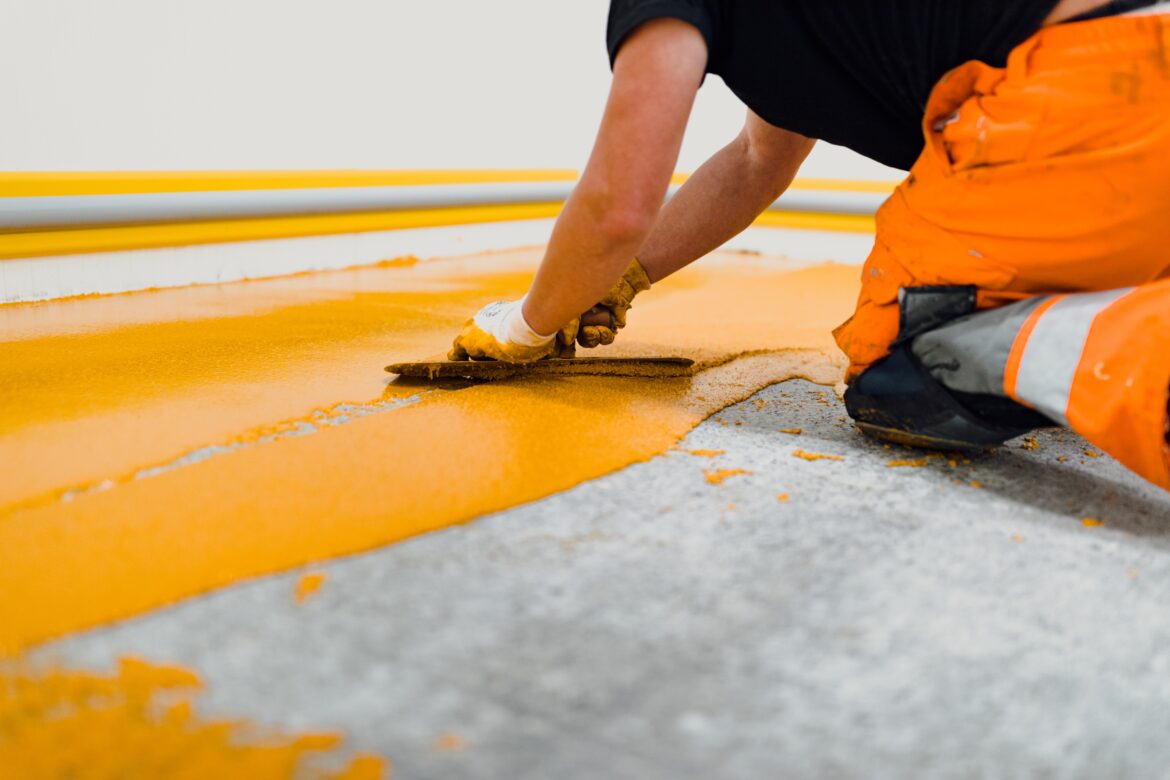

Industrial environments demand flooring that can withstand heavy loads, chemical exposure, and constant wear. Traditional materials such as concrete or tiles often fail to meet these requirements over time. This is why industrial resin flooring has become one of the most widely used solutions across factories, warehouses, and commercial facilities.
What Is Industrial Resin Flooring?
Industrial resin flooring is a seamless surface created by applying a mixture of synthetic resin and hardener onto a prepared substrate. Once cured, it forms a highly durable, non-porous, and long-lasting surface.
The key advantages of industrial resin flooring include:
- Exceptional durability under heavy machinery and traffic
- High resistance to chemicals, oils, and solvents
- Seamless and hygienic finish (easy to clean)
- Customisable slip resistance and appearance
- Low maintenance requirements
Because of these properties, resin flooring is commonly used in industries such as manufacturing, food processing, pharmaceuticals, and logistics.
However, what is often overlooked is that not all resin floors are the same. Choosing the best type depends on the environment and operational demands. The three main types are epoxy, polyurethane (PU), and methyl methacrylate (MMA).
Epoxy flooring is a widely used industrial resin system. It is known for its, affordability, and versatility. It is more commonly used as an epoxy coating rather than in heavy duty industrial environments.
Key Features:
- Excellent adhesion to concrete
- Strong resistance to chemicals and spills
- Smooth, seamless, and easy-to-clean surface
Epoxy floors are particularly suitable for warehouses or spaces that don’t require heavy duty industrial-level performance.
Advantages:
Epoxy is widely regarded as one of the most cost-effective industrial resin flooring solutions.
Limitations:
- Limited flexibility (can crack under movement or thermal stress)
- Poor UV resistance (may yellow over time)
Best for: General industrial use where durability and cost-effectiveness are key.
Polyurethane flooring is more flexible than epoxy and is designed to handle extreme conditions, particularly thermal shock and mechanical impact.
Key Features:
- High flexibility and elasticity
- Superior resistance to thermal expansion and contraction
- Excellent resistance to abrasion and chemicals
- Can withstand high temperatures (often up to 120–150°C)
Advantages:
PU flooring is ideal for environments where temperature changes are frequent, such as food production areas or industrial kitchens. Its flexibility prevents cracking and damage caused by heavy machinery or dropped tools.
Limitations:
- Higher cost than epoxy
- Reduced aesthetics
Best for: Food processing plants, cold storage facilities, and heavy-duty industrial environments.
MMA resin flooring is a high-performance system known best for its extremely fast curing time.
Key Features:
- Rapid curing (often within hours)
- Can be installed in low temperatures
- High durability and chemical resistance
- Minimal downtime during installation
- Flexibility to adapt aesthetics and slip resistance
Advantages:
MMA flooring is ideal when downtime must be minimised. Facilities can return to operation quickly, making it perfect for busy industrial sites or emergency repairs.
Limitations:
- Higher installation cost
- Strong odour during installation
Best for: Projects requiring fast turnaround, such as retail, logistics hubs, and operational factories.
How to Choose the Best Industrial Resin Flooring
There is no single “best” resin flooring for every situation. The right choice depends on your operational needs. Key factors to consider include:
- Mechanical Load
If your facility handles heavy machinery or forklifts, epoxy or PU systems are ideal due to their strength.
- Temperature Conditions
For environments with extreme heat or cold, polyurethane flooring performs better due to its thermal resistance.
- Downtime Requirements
If you cannot afford long shutdowns, MMA flooring is the best choice because of its rapid curing.
- Chemical Exposure
All resin systems offer chemical resistance, but PU and MMA typically perform better in aggressive environments.
- Budget
Epoxy is generally the most cost-effective option, while PU and MMA come at a higher initial cost but offer specialised benefits.
- Aesthetics
Epoxy and MMA resin flooring offer the best flexibility with regards to aesthetics.
Conclusion
Industrial resin flooring is one of the most effective solutions for modern industrial environments, offering unmatched durability, hygiene, and performance. Among the available options:
- Epoxy flooring is the most cost-effective option
- Polyurethane flooring excels in high-temperature and high-impact environments
- MMA flooring is ideal for fast installation and minimal downtime
Ultimately, the “best” industrial resin flooring depends on your specific operational requirements. By carefully assessing factors such as load, temperature, and installation constraints, businesses can select a flooring system that ensures long-term performance and cost efficiency.
Need Further Assistance?
If you’re unsure whether your project requires commercial resin flooring or industrial resin flooring, getting the specification right from the start is essential to avoid costly mistakes.
Our team has extensive experience in assessing environments and recommending the most suitable system based on your operational needs, traffic levels, and exposure conditions.
Contact us today to discuss your requirements, arrange a site survey, or receive a sample.
Author: Anna Dewdney