
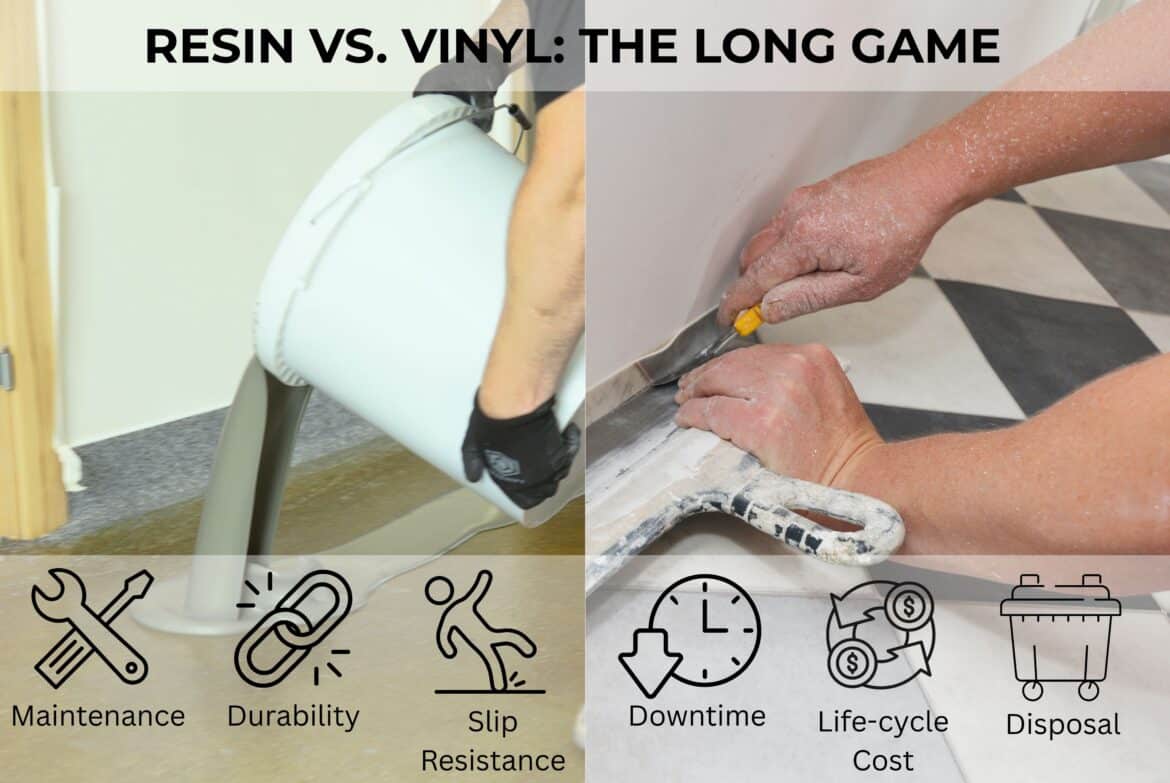

Over a 10-year period, when correctly specified and installed, resin flooring typically delivers superior durability, hygiene and physical and chemical resistance in demanding industrial and commercial settings, when compared to most types of vinyl. There are several factors that should be considered when choosing which is the best option for your premises.
What we mean by “resin” and “vinyl”
Resin Flooring: Resin flooring is applied on-site as a liquid—either poured or trowelled—to form a seamless, fully bonded surface. It comes in several varieties, such as epoxy, polyurethane, and MMA, and ranges from thin decorative coatings to heavy-duty systems between 9 mm and 12 mm thick.
Vinyl Flooring: Vinyl flooring is manufactured in sheets or tiles. They are produced off site and cut to fit the area when installed with adhesives and welded seams.
Lifespan and durability over 10 years
Resin Flooring: In medium to high-demand industrial and commercial environments, resin flooring systems often last more than 10 -20+ years. They deliver strong resistance to heavy traffic and chemical exposure and can typically be refreshed by applying a new coating rather than removing and replacing the entire floor.
Vinyl Flooring: While many vinyl suppliers claim a life expectancy of up to 25 years, and the material remains durable in low-traffic areas, it commonly experiences failure at joints and seams, which typically leads to more frequent repairs.
Life-cycle cost
Upfront Cost: Resin usually has a higher initial installation cost in comparison to vinyl.
Operation Cost: Resin flooring forms a chemical bond with the substrate, resulting in a durable surface that provides outstanding resistance to wear and impact. Resin forms a seamless and impermeable finish, which reduces weak spots, and in turn extends the floor’s lifespan and reduces the need for repairs. If repairs are needed, they can typically be carried out locally, rather than an over an expansive area, minimising disruption. Due to the bonding nature of resins, recoating the existing resin is an option. This reduces the need for removal of the existing floor reducing costs and time during the refurbishment.
In contrast, vinyl flooring often requires more frequent maintenance, particularly in high-traffic areas. Once vinyl begins to show signs of wear, tear, or lifting at the edges / seams, it may be necessary to replace larger sections or even the entire floor.
Maintenance, hygiene and downtime
A key advantage of resin flooring is its seamless installation. With no joints or seams for dirt or bacteria to accumulate, it is an ideal choice for environments where hygiene is of utmost importance. There are also fast curing systems available which are beneficial in reducing downtime during the initial installation.
Vinyl flooring is generally quicker and less disruptive to install. Vinyl sheet and tiles are welded together, and the seams are common trouble spots that are prone to failure often requiring more maintenance. These seams can also be good breading grounds for bacteria and build up of dirt.
Repairability and refurbishment
Resin floors can be easily restored through targeted repairs. When the times comes to renew the surface to rejuvenate the texture or aesthetics a new coating can be applied rather than removing the existing finish.
Patch repairs can be undertaken with vinyl flooring, but these often create more seams that can increase the risk of future failure. Larger areas or sections may need to be repaired as a result.
Aesthetics and Design Flexibility
Vinyl flooring offers excellent flexibility in terms of aesthetics. Advances in digital printing have provided the ability to create a wide range of colours and designs. Creating patterns and designs can be easily incorporated.
While resin flooring was traditionally limited in aesthetic appeal, it is now possible to create truly unique designs. The system can be broadcast with coloured flakes to achieve an attractive, bespoke finish, or with aggregates to increase slip resistance.
Slip resistance
Vinyl flooring is typically supplied in large rolls and, although slip-resistant variants exist, the anti-slip properties can diminish over time with wear. Once the slip-resistant surface is compromised, the only solution is usually to replace the entire floor.
In contrast, resin flooring offers greater flexibility in achieving and maintaining slip resistance. By broadcasting aggregates, such as quartz or aluminium oxide, into the resin surface, it is possible to create varying levels of grip tailored to specific environments. Furthermore, due to the chemical bonding properties of resin, the floor can be overcoated or resurfaced to restore slip resistance without needing a full replacement. This makes resin flooring a more durable and sustainable option in areas where safety underfoot is a priority.
Disposal and end of life considerations
Once cured, resin forms a thermoset material and most commonly has to be mechanically broken up and disposed of as construction waste. The longer lifespan of resin flooring can help to mitigate the concerns surrounding disposal by reducing the need to frequent replacement.
Vinyl flooring cannot usually be recycled because it contains, adhesives, backing materials and contaminants. It is therefore usually sent to landfill. Environmental concerns surrounding vinyl flooring primarily relate to the frequency with which it needs to be replaced or repaired, contributing to waste generation over time.
Choosing the right flooring solution for you
The decision between vinyl and resin flooring depends on the particular needs of the project. Initial installation costs should be balanced against long-term expenses, including maintenance and potential refurbishment. Often, choices are made based solely on upfront costs, without accounting for future repair or replacement expenses.
Factors including, aesthetics and hygiene can also greatly influence the suitability of the flooring selection.
By understanding these differences, specifiers and decision-makers can select a flooring solution that aligns with functional needs, budget constraints, and sustainability goals.
Author: Anna Dewdney